
For decades, conservation professionals have relied on a patchwork of standards to evaluate how well their environments protect cultural heritage. ASHRAE climate classes tell you about room control tightness. The IPI Preservation Index estimates cellulose decay rates. The CCI's 10 Agents of Deterioration provide a qualitative risk framework. Each is valuable — but none answers the fundamental question: how well is this room preserving these specific objects?
Today, we're introducing the Conservation Quality Index (CQI) — a single 0–100 score that bridges that gap. Think of it as PUE for museums: a unified metric that drives action, enables benchmarking, and creates a shared language between conservation and operations teams.
The Gap in Existing Standards
ASHRAE Classes (AA–D)
Room-centric only. Classifies control tightness but ignores what's actually in the room.
IPI Preservation Index
Material-generic. Single decay estimate based on cellulose research — ignores light, UV, pollutants, pests.
CCI 10 Agents
Qualitative risk framework. Invaluable for planning but no real-time quantitative scoring.
The missing piece: no existing metric combines what the room is doing with what is in the room to produce a single, real-time, benchmarkable score.
How CQI Works
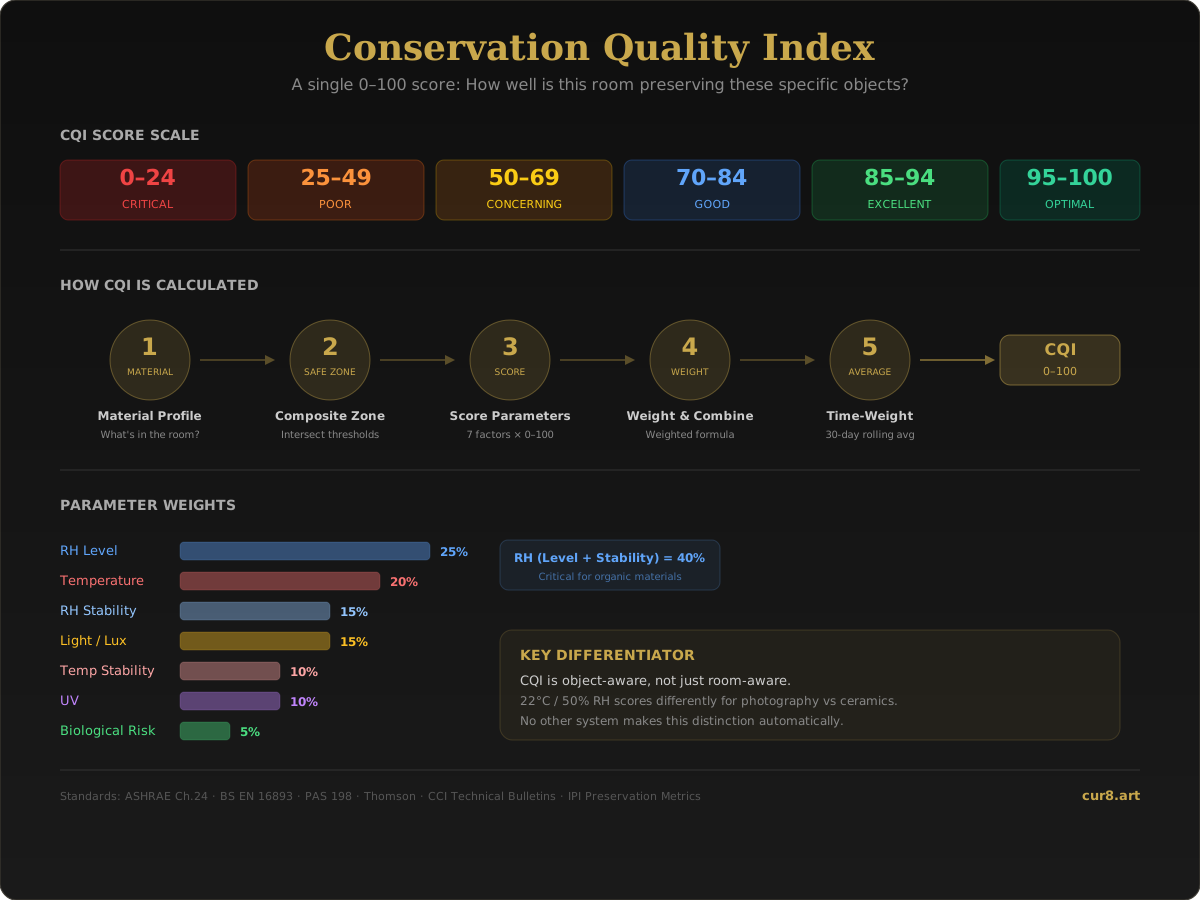
CQI is computed in five steps, running automatically on sensor data every five minutes.
Define the Material Profile
Each room gets a material composition — for example, oil paintings 60%, gilded wood frames 25%, works on paper 15%. Each material type has a defined optimal envelope from published conservation standards (BS EN 16893, PAS 198, ASHRAE Ch.24, CCI Technical Bulletins).
Compute the Composite Safe Zone
The system intersects all material safe zones in the room. The most vulnerable material sets the ceiling for each parameter, weighted by proportion. This is what makes CQI object-aware rather than just room-aware.
Score Each Parameter (0–100)
Seven environmental parameters are scored independently based on deviation from the composite optimal range.
Weight and Combine
Sub-scores are combined using a weighted formula. RH (level + stability) accounts for 40% of the total, reflecting its critical importance for organic materials. Weights are configurable per institution.
Time-Weight
The published CQI is a rolling 30-day average. This prevents a single bad hour from tanking the score while capturing sustained poor conditions. Instantaneous readings are available as real-time sub-scores for alerting.
The Seven Parameters
Click to enlarge
Reading the Score
Real-World Examples
Gallery A — Old Masters
Oil paintings 60% · Gilded wood frames 25% · Works on paper 15%
Conditions: 21°C, 50% RH, 120 lux, 15 µW/lm UV, ±1°C / ±3% RH stability over 24h. All parameters within optimal range. Weakest sub-score is RH at 88 — 50% sits slightly above ideal for the paper component. National loan eligible.
Gallery B — Photography
Photographs 80% · Works on paper 20%
Conditions: 18°C, 40% RH, 50 lux, 5 µW/lm UV. Exemplary. Cool temperature and low RH are ideal for photographic materials. Subdued lighting protects light-sensitive emulsions. Meets international loan standards.
Gallery C — Mixed Media
Oil paintings 30% · Textiles 25% · Metals 20% · Ceramics 15% · Paper 10%
Conditions: 24°C, 62% RH, 250 lux, 60 µW/lm UV, ±8% RH fluctuation over 24h. Three critical issues flagged:
- ● RH fluctuation exceeds safe limit for oils and textiles
- ● Light at 250 lux is excessive for paper (max 50)
- ● 62% RH at 24°C creates active mould risk
Actions: stabilise HVAC, reduce lighting levels, relocate paper items.
Why It Matters
CQI is the only metric that combines material awareness with real-time multi-parameter scoring. The key differentiator: it's object-aware, not just room-aware. A room at 22°C and 50% RH scores differently for photography than for ceramics. No other system makes this distinction automatically.
Loan decisions backed by data
Standardised scores for condition reports and insurance assessments.
Operations & conservation aligned
A single number both teams understand and can act on.
Benchmarking at every level
Compare across rooms, buildings, and institutions.
Diagnostic, not just descriptive
When the score drops, CQI tells you which parameter and what to do.
Built into Cur8.art
CQI is computed automatically within the Cur8.art platform. Environmental sensors feed data every five minutes, and the score is calculated edge-side on the gateway hardware — reducing cloud dependency and ensuring real-time responsiveness. Dashboard views include institution-wide CQI, per-zone breakdowns, trend analysis with event annotations, and loan-ready period reports.
CQI draws on established conservation science — ASHRAE Chapter 24, BS EN 16893, PAS 198, Thomson's The Museum Environment, and CCI Technical Bulletins — and turns it into something actionable, automatic, and always on.
Interested in seeing CQI in action at your institution?
Schedule a DemoReferences & Standards
- ASHRAE Handbook: HVAC Applications, Chapter 24 (2019/2023)
- BS EN 16893:2018 — Conservation of Cultural Heritage
- PAS 198:2012 — Managing environmental conditions for cultural collections
- Garry Thomson — The Museum Environment (2nd ed., 1986)
- Stefan Michalski — The Ideal Climate, Risk Management, the ASHRAE Chapter (Getty, 2007)
- CCI Technical Bulletins — Canadian Conservation Institute
- IPI Preservation Metrics — Image Permanence Institute, RIT (1995–present)